Supercar Technology Innovation Guide: The Future of Performance
Supercar technology guide: how carbon-fiber tubs, active aero, hybrids, dual-clutch gearboxes and software shape performance in the McLaren, Ferrari and Lamborghini.…
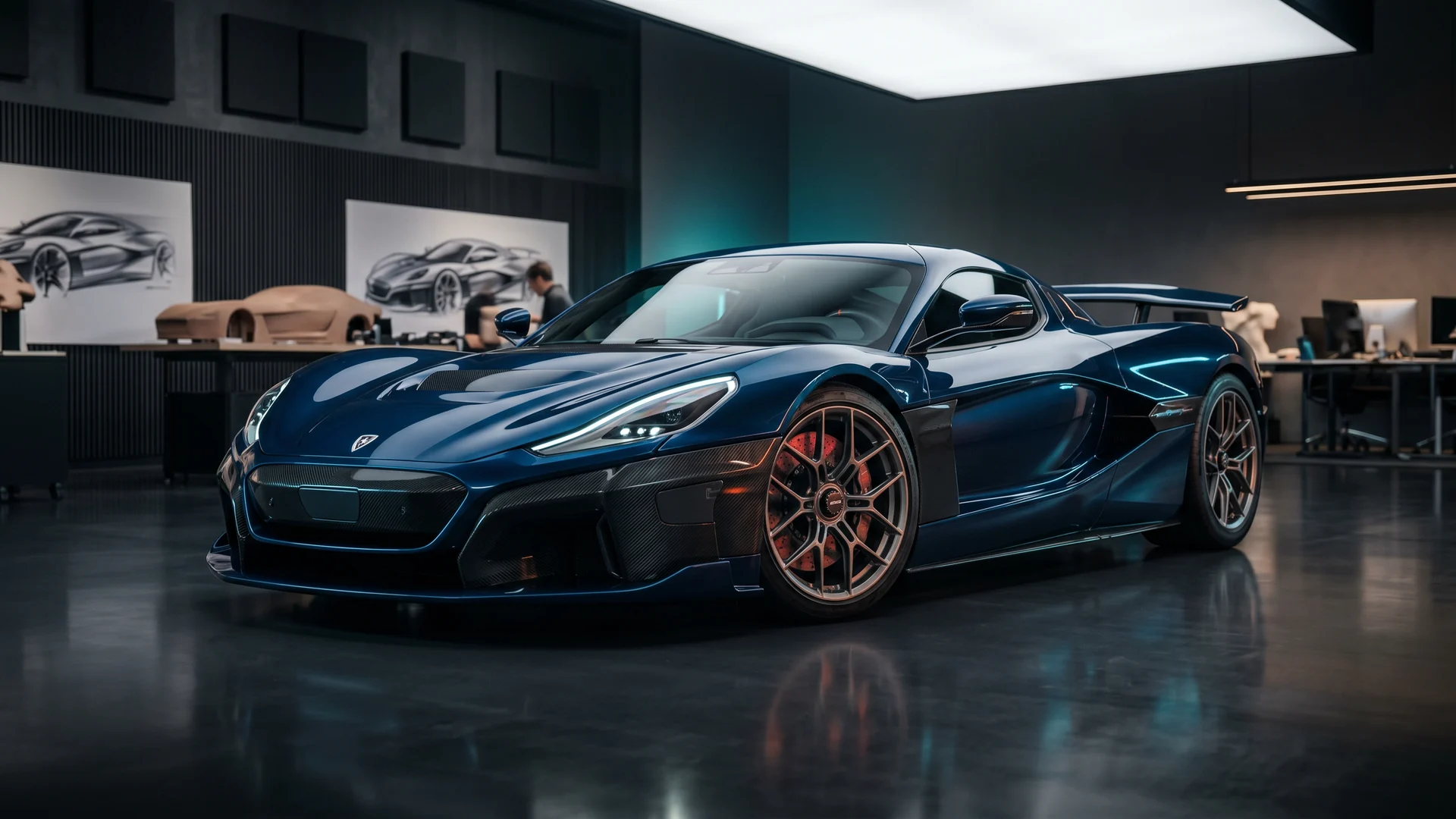
Modern supercar performance comes from five core technologies: carbon-fiber monocoques, active aerodynamics, hybrid powertrains, dual-clutch transmissions, and software-managed dynamics like torque vectoring.
Key Takeaways
- A CFRP monocoque offers roughly five times the stiffness-to-weight ratio of steel; McLaren's MCLA tub in the Artura weighs just 82 kg yet exceeds 35,000 Nm per degree of torsional rigidity.
- Carbon-tub manufacturing method sets cost and exclusivity: McLaren's RTM runs $15,000 to $30,000, Pagani's pre-preg autoclave $80,000 to $150,000, and Lamborghini's forged composite $5,000 to $10,000 per tub.
- Active aero adapts in real time: the McLaren P1's dual-mode wing extends 300 mm, the Ferrari 488 Pista added an F1-style S-duct, and the Porsche 911 GT3 RS (992) uses driver-controllable DRS that cuts drag by about 20%.
- Hybrids follow three philosophies: Ferrari's SF90 torque-fill (986 hp), Lamborghini's naturally aspirated V12 Revuelto (1,001 hp), and McLaren's weight-minimizing Artura (671 hp, hybrid system adds only 130 kg).
- The 8-speed dual-clutch transmission is universal, with the Graziano (Dana) unit handling over 1,000 Nm and shifting in 50 to 100 milliseconds across the SF90, Revuelto, and Artura.
- Manual-focused holdouts persist: Gordon Murray Automotive's six-speed manual in the T.50 and T.33, Pagani's Xtrac seven-speed manual in the Utopia, and Koenigsegg's nine-speed Light Speed Transmission.
- Software defines character: central dynamics controllers manage torque vectoring, Brembo brake-by-wire, and MR or DSSV dampers, with MR systems adjusting each corner up to 1,000 times per second.
🌐 Also available in: Deutsch
The Technology Filter: How Supercar Engineering Reaches the Road
Motorsport as Technology Incubator
Road-Legal Constraints That Shape Innovation
The Trickle-Down Timeline
The supercar and hypercar segment functions as the automotive industry’s research laboratory. Technologies that debut on million-dollar exotics, carbon-fiber monocoques, dual-clutch transmissions, active aerodynamics, torque-vectoring all-wheel-drive, hybrid assist systems, filter down to mass-market vehicles over a decade or more. Understanding these core technologies is essential for any buyer evaluating competing supercars, because the specification sheet tells only a fraction of the story. Two cars with similar horsepower figures on paper can deliver radically different driving experiences depending on how that power is generated, transmitted, and managed.
Carbon-Fiber Construction: The Structural Foundation
Monocoque vs. Spaceframe Architecture
Carbon-fiber-reinforced polymer (CFRP) is the defining structural material of the modern supercar. A CFRP monocoque, a one-piece tub forming the passenger cell, offers roughly five times the stiffness-to-weight ratio of steel and approximately twice that of aluminum. The McLaren Carbon Lightweight Architecture (MCLA) monocoque used in the Artura weighs only 82 kg (181 lbs) yet provides torsional rigidity exceeding 35,000 Newton-meters per degree of twist. For comparison, a typical steel-bodied luxury sedan might measure 15,000 to 20,000 Nm per degree. This rigidity is not an abstract engineering figure, it directly affects every aspect of the driving experience. A rigid chassis allows the suspension to do its job precisely, without the structure flexing and absorbing suspension movement. The result is more accurate steering, more predictable handling at the limit, and better communication of road surface information to the driver through the seat and steering wheel.
Manufacturing Techniques: Autoclave to Forged Composite
The manufacturing technique used to create a carbon tub dramatically affects its cost, quality, and production rate. McLaren uses resin-transfer molding (RTM) for its volume models such as the Artura and 750S. In the RTM process, dry carbon-fiber fabric is placed into a mold, the mold is closed, and resin is injected under pressure. The resin infiltrates the fiber, and the part cures. RTM produces consistent quality at relatively high speed, approximately one tub per day per mold, at a cost of roughly $15,000 to $30,000 per tub. Pagani uses pre-preg carbon fiber cured in an autoclave, a pressurized oven, at high pressure and temperature. Pre-preg material has the resin already impregnated into the fiber and must be stored frozen to prevent premature curing. The autoclave process, identical to that used in Formula 1 and aerospace, produces maximum strength and minimum weight, but each tub requires days of hand layup and curing time, at a cost of $80,000 to $150,000. Lamborghini pioneered forged composite, short, randomly oriented carbon fibers suspended in resin and compression-molded in a heated press. Forged composite can be formed into complex shapes faster than traditional layup, and it is dramatically cheaper, roughly $5,000 to $10,000 per tub, but its specific stiffness is lower than continuous-fiber pre-preg. The Aventador used a hybrid approach: a pre-preg carbon central tub with forged composite front and rear sub-structures.
The Carbon Fiber Supply Chain
At the extreme, the Aston Martin Valkyrie’s carbon tub integrates the engine as a stressed member, eliminating the rear subframe entirely. The tub alone likely exceeds $200,000 in production cost. It is the most extreme application of carbon-fiber monocoque construction in any road-registered vehicle, and it will likely never be repeated at this level of expense and complexity.
Active Aerodynamics: The Moving Bodywork
DRS and Active Wings Explained
Active aerodynamics: aerodynamic surfaces that physically move in response to vehicle speed, braking demand, cornering load, and driver-selected mode, is the technology that most visibly separates modern supercars from their predecessors. The McLaren P1 introduced a dual-mode rear wing in 2013 that could extend rearward by 300 mm (12 inches) and increase its angle of attack in Track mode, boosting rear downforce. The wing also deployed as an air brake under heavy braking. The Ferrari 488 Pista introduced two significant active aero innovations in 2018. The front S-duct, an aerodynamic channel inspired by Formula 1, draws air from a high-pressure zone on the upper surface of the front bumper, routes it through a duct inside the hood, and exhausts it through a vent on the upper hood surface into a low-pressure zone. This increases front-axle downforce without the aerodynamic drag penalty of a larger front splitter. The Pista also introduced active diffuser flaps in the rear underbody diffuser. Under steady-state high-speed driving, the flaps rotate open to stall the diffuser, reducing drag. Under braking, they close, restoring downforce exactly when the driver needs rear-axle grip for stability.
Underbody Aerodynamics & Ground Effect
The Porsche 911 GT3 RS (992) took active aero a significant step further with a Drag Reduction System (DRS) integrated into its swan-neck rear wing. At the press of a button on the steering wheel, or automatically in certain driving modes, a flap in the upper wing element flattens, reducing drag by roughly 20% and downforce proportionally. This is Formula 1 DRS technology, driver-controllable, on a road car. The GT3 RS also features active front-wheel arch vents that open to relieve high-pressure air buildup in the wheel wells, and an active radiator air exit that adjusts to balance cooling drag against downforce.
Brake Cooling & Thermal Management
The Ferrari SF90 XX Stradale introduced an active shut-off Gurney flap, a small lip at the trailing edge of its fixed rear wing that pivots between a low-drag position and a high-downforce position. Combined with the car’s active front underbody and rear diffuser management, the SF90 XX generates 530 kg (1,168 lbs) of downforce at 250 km/h (155 mph), more than the LaFerrari hypercar. The Bugatti Tourbillon integrates aerodynamics and active suspension into a unified system. The rear wing extends progressively with speed, deploys as an air brake under heavy braking (generating approximately 0.6G of deceleration from aerodynamic drag alone), and the entire vehicle ride height adjusts, lowering by 25 mm (1 inch) in top-speed mode to reduce frontal area and underbody airflow. The active systems operate in concert, with the suspension, aero, and powertrain communicating over a central vehicle dynamics controller at millisecond frequencies.
Hybrid Powertrains: Electric Motors as Performance Multipliers
Torque Fill: Eliminating the Power Gap
The hybridization of the supercar, launched by the LaFerrari, P1, and 918 Spyder in 2013, has accelerated to the point where every major manufacturer now offers or is developing a hybrid supercar. The Ferrari SF90 Stradale illustrates the current state of the art. Its 4.0-liter twin-turbocharged V8, derived from the F8 Tributo’s engine but with extensive modifications, produces 780 horsepower and drives the rear axle through an eight-speed dual-clutch transmission. Three electric motors augment it: two on the front axle (one per wheel, providing independent torque vectoring) and one mounted between the engine and transmission. Total system output is 986 horsepower. The front electric motors enable electric-only all-wheel drive, which Ferrari uses for a dedicated eDrive mode with approximately 25 km (15.5 miles) of electric-only range from a 7.9 kWh lithium-ion battery. More significantly, the electric motors fill the torque gap while the twin turbochargers spool up, eliminating the perceptible turbo lag that was the most frequent criticism of Ferrari’s turbocharged V8 era. From the driver’s seat, the SF90’s power delivery feels naturally aspirated, instantaneous throttle response, despite being produced by a highly turbocharged engine.
KERS and MGU-K: F1-Derived Systems
The Lamborghini Revuelto takes a philosophically different approach. Its new 6.5-liter naturally aspirated V12, internally designated L545, and sharing no major components with the Aventador’s V12, produces 814 horsepower at 9,250 RPM. Three electric motors (two front, one rear-integrated) contribute to a combined 1,001 horsepower. Unlike the SF90, the Revuelto’s V12 is naturally aspirated by design, a deliberate engineering choice to preserve the linear, soaring power delivery and 9,500 RPM soundtrack that define Lamborghini’s flagship identity. The electric motors serve as torque fill at low and medium RPM where a naturally aspirated engine produces less twist, creating a power curve that feels almost turbocharged in its mid-range urgency while retaining the top-end scream of a naturally aspirated twelve-cylinder. The 3.8 kWh battery, mounted in what was the transmission tunnel of the Aventador, provides roughly 10 km (6 miles) of electric range. Lamborghini is explicit: this is not a fuel-economy exercise. The hybrid system exists solely to enhance performance.
Battery Technology & Regeneration Strategies
The McLaren Artura demonstrates a third hybrid philosophy: weight minimization. It pairs a new 3.0-liter twin-turbocharged 120-degree V6, McLaren’s first in-house V6, producing 577 horsepower at 7,500 RPM, with a single axial-flux electric motor (94 horsepower) embedded in the transmission bellhousing, for a combined 671 horsepower. The axial-flux motor is shaped like a pancake rather than a cylinder, a form factor that allows it to be packaged in the bellhousing without extending the transmission’s length. The entire hybrid system, including the 7.4 kWh battery, adds only 130 kg (287 lbs). The Artura’s dry weight of 1,498 kg (3,303 lbs) makes it the lightest hybrid supercar in its performance class. For McLaren, the engineering priority was clear: electrification must not make the car heavier than a comparable non-hybrid supercar.
Dual-Clutch Transmissions: The Universal Standard
How DCTs Achieve Sub-100ms Shifts
The dual-clutch transmission (DCT) has become universal across the supercar segment. A DCT contains two separate clutches housed in a single unit, one clutch for odd-numbered gears (1st, 3rd, 5th, 7th), one for even-numbered gears (2nd, 4th, 6th, 8th). While the car accelerates in an odd gear, the even-gear clutch pre-selects the next expected gear. When the shift command arrives, from a paddle pull by the driver or from the transmission control unit in automatic mode, one clutch opens as the other closes. The gear change occurs in 50 to 100 milliseconds, faster than any human can shift a manual transmission and faster than even the best automated single-clutch systems. The 8-speed dual-clutch gearbox developed by Graziano (part of the Dana Corporation) and used across the Ferrari SF90, Lamborghini Revuelto, and McLaren Artura platforms is the current industry benchmark. It handles over 1,000 Nm (738 lb-ft) of torque while weighing less than the 7-speed unit it replaced. Porsche’s in-house 8-speed PDK (Porsche Doppelkupplung), manufactured by ZF to Porsche’s specification, is widely regarded as the best-calibrated DCT in the industry. Its shift logic is so intuitive and predictive in automatic mode that manual paddle input becomes almost optional, the gearbox consistently selects the correct gear for the corner, the gradient, and the driver’s apparent intent based on throttle and brake inputs.
Gearbox Control Software & Predictive Shifting
Single-Clutch Purists: The Manual Renaissance
A small but vocal cohort of manufacturers is deliberately resisting the DCT orthodoxy. Gordon Murray Automotive specifies a six-speed manual for both the T.50 and T.33, arguing that driver engagement, the physical and mental satisfaction of executing a perfect heel-and-toe downshift, trumps shift speed. Pagani offers a true seven-speed manual in the Utopia, supplied by Xtrac, alongside an automated single-clutch alternative. Koenigsegg developed the revolutionary Light Speed Transmission (LST), a nine-speed system using multiple clutches that can skip directly from any gear to any gear without stepping through intermediate ratios. The LST is not a DCT, not a manual, and not a conventional automatic; it is a Koenigsegg-specific solution that eliminates the sequential-shift limitation of all other transmissions. For the minority of buyers who value mechanical connection over outright lap-time performance, these alternatives represent the last stand of the manually operated supercar transmission.
Torque Vectoring, Brake-by-Wire, and the Software Layer
Mechanical vs. Electronic Torque Vectoring
Torque vectoring: the ability to actively distribute engine power between the left and right wheels on an axle, has transformed how supercars handle. Traditional mechanical limited-slip differentials react to wheel slip; they cannot proactively apportion torque to optimize cornering. Electronic torque vectoring, by contrast, can overdrive the outside rear wheel during cornering, creating a yaw moment that rotates the car into the corner. The Ferrari SF90 Stradale achieves torque vectoring electrically using its two independent front-axle motors. Combined with the rear electric motor and the V8, the car has four independently controllable power sources whose torque outputs are managed by a central dynamics controller. The controller integrates data from accelerometers, yaw sensors, steering angle, wheel speed, and brake pressure to determine the optimal torque distribution at each corner, updated at hundreds of times per second.
Brake-by-Wire: Feel vs. Precision
Vehicle Dynamics Controllers
Brake-by-wire, in which the brake pedal is not hydraulically connected to the calipers, is a necessary consequence of hybrid powertrains that must blend regenerative braking (from electric motors recovering kinetic energy) with friction braking (from traditional calipers and rotors). The Ferrari 296 GTB and SF90 Stradale use a brake-by-wire system supplied by Brembo that Ferrari spent more development time calibrating than any other vehicle system. The challenge is pedal feel: a brake-by-wire pedal that feels artificial, springy, nonlinear, or disconnected, destroys driver confidence at the limit. Ferrari’s calibration uses a pedal-force simulator that mimics the feel of a hydraulic system so accurately that most drivers cannot distinguish it from a conventional brake system in blind testing. Carbon-ceramic rotors remain standard on nearly every supercar above $200,000, providing roughly 50% weight savings versus iron and effectively lifetime durability under street driving. The downside: replacement cost of $18,000 to $35,000 per axle at a dealer if they are ever damaged or worn through track use.
Key Takeaways
- Carbon-fiber is the structural foundation of every modern supercar: Carbon tubs provide five times the stiffness-to-weight of steel. Manufacturing technique. RTM (McLaren, $15K-$30K), pre-preg autoclave (Pagani, $80K-$150K), or forged composite (Lamborghini, $5K-$10K), determines cost, quality, and exclusivity.
- Active aerodynamics is the most visible technology differentiator: DRS wings, active diffusers, shut-off Gurney flaps, and moving body panels manage the trade-off between downforce and drag in real time, adapting to speed, braking, and cornering.
- Hybrid systems are now standard, with three distinct philosophies: Ferrari’s torque-fill approach, Lamborghini’s naturally aspirated V12 preservation, and McLaren’s weight-minimization strategy all use electric motors to enhance combustion engines without replacing them.
- The 8-speed DCT is universal; manual alternatives survive in boutique applications: Graziano’s 8-speed DCT handles 1,000+ Nm and shifts in under 100ms. Pagani, GMA, and Koenigsegg (LST) preserve manual and manual-adjacent options for purists.
- Software is the invisible technology layer: Torque vectoring, brake-by-wire blending, active suspension, and stability control are managed by central dynamics controllers making thousands of calculations per second. The calibration of these software systems now defines a supercar’s character as much as its hardware.
Active Suspension: The Quiet Revolution
Magnetorheological Dampers
Modern supercar suspensions manage an extraordinary set of competing demands: compliance for street use, stiffness for track work, aerodynamic platform control at 200+ mph, and the ability to lift the nose for speed bumps. The technological solutions are increasingly sophisticated. Magnetorheological (MR) dampers, used by Ferrari (SCM-E magnetorheological suspension), Lamborghini (Magnetic Ride), and Audi (Audi Magnetic Ride in the R8), contain a synthetic hydrocarbon fluid with suspended micron-scale iron particles. When an electromagnetic coil in the damper piston is energized, the iron particles align into chains perpendicular to the fluid flow, instantaneously increasing the fluid’s viscosity. The range of damping force adjustment from fully soft to fully firm is approximately 3:1 to 5:1, and the system can adjust each damper independently at a frequency of up to 1,000 hertz, one thousand adjustments per second per corner. The control logic reads accelerometers, wheel position sensors, steering angle, brake pressure, and throttle position to determine the optimal damper setting for each corner in real time. The result is a car that can be supple over broken pavement in Comfort mode and track-firm in Race mode, with the transition occurring in milliseconds rather than the seconds required by a manually adjustable system.
Predictive Suspension & Road Scanning
Lift Systems for Daily Usability
Multimatic DSSV (Dynamic Suspension Spool Valve) dampers represent an alternative philosophy. Used on the Ford GT, Mercedes-AMG ONE, and Aston Martin Valkyrie, DSSV dampers replace the conventional shim-stack valving of most dampers with a precision-machined spool valve. As the damper piston moves, the spool valve reveals or covers ports of specific sizes, providing three distinct damping regimes: a low-speed compression curve for body control, a mid-speed rebound curve for wheel control, and a high-speed blow-off circuit that opens under sharp impacts like curbing. The tuning is purely mechanical, there are no electronic controls, no solenoids, no software. The entire damper curve is defined by the geometry of the spool valve ports, machined to tolerances measured in microns. The advantage is absolute consistency: DSSV dampers do not overheat, do not require software calibration, and produce identical behavior on lap one and lap 100. The disadvantage is that the tuning is fixed, you cannot press a button to switch between Comfort and Track damping curves. The Ford GT’s street and track damper settings are both excellent, but they are both baked into the mechanical design with no ability to switch between them.
The Digital Twin: Simulation Before Production
CFD, FEA, and Virtual Wind Tunnels
Reducing Prototype Count & Development Time
Driver-in-the-Loop Simulators
A technology that receives less attention but is fundamental to modern supercar development is the digital twin, a complete virtual model of the vehicle that exists in simulation software before any physical prototype is built. Ferrari, McLaren, and Porsche now simulate every aspect of a new car’s performance, aerodynamics, structural stiffness, suspension kinematics, powertrain thermal management, crash safety, in a unified digital environment. The digital twin allows engineers to test thousands of design iterations in the time it would take to build and test a single physical prototype. McLaren’s development of the Artura, for example, involved over 10,000 hours of computational fluid dynamics (CFD) simulation before the first wind-tunnel model was constructed. The simulation models the airflow around and through the car at a resolution of individual cubic centimeters, predicting drag, downforce, and cooling airflow with sufficient accuracy that the physical wind tunnel serves primarily as a validation tool rather than a development tool. This technology reduces the development cycle from concept to production by 12 to 18 months compared to the pre-digital era, and it allows manufacturers to bring cars to market faster in an increasingly competitive industry. The digital twin also enables over-the-air updates to vehicle dynamics software, because the simulation environment can model how a software change affects vehicle behavior across thousands of scenarios before the update is deployed to customer cars.
Frequently Asked Questions (FAQ)
What are the core technologies that define a modern supercar like the McLaren Artura or Ferrari SF90?
Five core technologies define modern supercars: carbon-fiber monocoque construction, active aerodynamics, hybrid powertrains, dual-clutch transmissions, and a software layer managing torque vectoring and dynamics. These innovations debut on million-dollar exotics and filter down to mass-market vehicles over a decade, explaining why two cars with similar horsepower can drive very differently.
How much does a carbon-fiber tub cost to make for a supercar?
Cost depends on the manufacturing method. McLaren's resin-transfer molding runs roughly $15,000 to $30,000 per tub, Pagani's pre-preg autoclave process costs $80,000 to $150,000, and Lamborghini's forged composite is cheapest at $5,000 to $10,000. The Aston Martin Valkyrie's tub alone likely exceeds $200,000 in production cost.
What is DRS on the Porsche 911 GT3 RS and how does it work?
DRS, or Drag Reduction System, is Formula 1 technology integrated into the Porsche 911 GT3 RS (992) swan-neck rear wing. At the press of a steering-wheel button, or automatically in certain modes, a flap in the upper wing element flattens, reducing drag by roughly 20% and downforce proportionally for higher straight-line speed.
How does Ferrari's SF90 Stradale produce 986 horsepower with a hybrid system?
The Ferrari SF90 Stradale combines a 4.0-liter twin-turbocharged V8 producing 780 horsepower with three electric motors: two on the front axle and one between engine and transmission. Total system output is 986 horsepower. The electric motors also fill the torque gap while the turbochargers spool, eliminating the perceptible turbo lag of earlier Ferrari V8s.
Why does the Lamborghini Revuelto keep a naturally aspirated V12 instead of turbocharging?
Lamborghini chose a naturally aspirated 6.5-liter V12, designated L545, to preserve the linear, soaring power delivery and 9,500 RPM soundtrack defining its flagship identity. The three electric motors, contributing to a combined 1,001 horsepower, serve as torque fill at low and medium RPM. The hybrid system exists solely to enhance performance, not fuel economy.
How fast does a dual-clutch transmission shift in a supercar?
A dual-clutch transmission changes gears in 50 to 100 milliseconds, faster than any human shifting a manual and faster than the best single-clutch systems. It uses two clutches, one for odd gears and one for even gears, so the next gear is pre-selected. The Graziano 8-speed DCT handles over 1,000 Nm of torque.
Which supercar makers still offer manual transmissions instead of the dual-clutch?
A small group resists the dual-clutch standard. Gordon Murray Automotive specifies a six-speed manual in the T.50 and T.33, Pagani offers a true seven-speed manual supplied by Xtrac in the Utopia, and Koenigsegg developed the nine-speed Light Speed Transmission that can skip directly between any gears without stepping through intermediate ratios.
What is brake-by-wire and why do hybrid supercars need it?
Brake-by-wire means the brake pedal is not hydraulically connected to the calipers, which is necessary to blend regenerative braking from electric motors with friction braking. The Ferrari 296 GTB and SF90 use a Brembo system Ferrari calibrated extensively, using a pedal-force simulator so accurate most drivers cannot distinguish it from a conventional hydraulic brake in blind testing.
More from Magazine
Future of Supercars – Electric Revolution and Beyond
The future of supercars: Ferrari’s 2025 electric flagship, Porsche’s synthetic eFuel, Rimac’s record-breaking EVs and why the V12 su…

Supercar Rental Worldwide Guide – Drive Your Dream Car Today
Supercar rental guide: daily rates from $500 to $20,000+, security deposits, insurance rules, top locations worldwide, and track packages explained.…
Hypercar vs Supercar – The Complete Comparison Guide
Hypercar vs supercar explained: production volume, $200K-$5M+ price brackets, horsepower, downforce and ownership costs that separate the two tiers.…