Hypercar vs Supercar: The Complete Comparison Guide
Hypercar vs supercar explained: production volume, $200K-$5M+ price brackets, horsepower, downforce and ownership costs that separate the two tiers.…
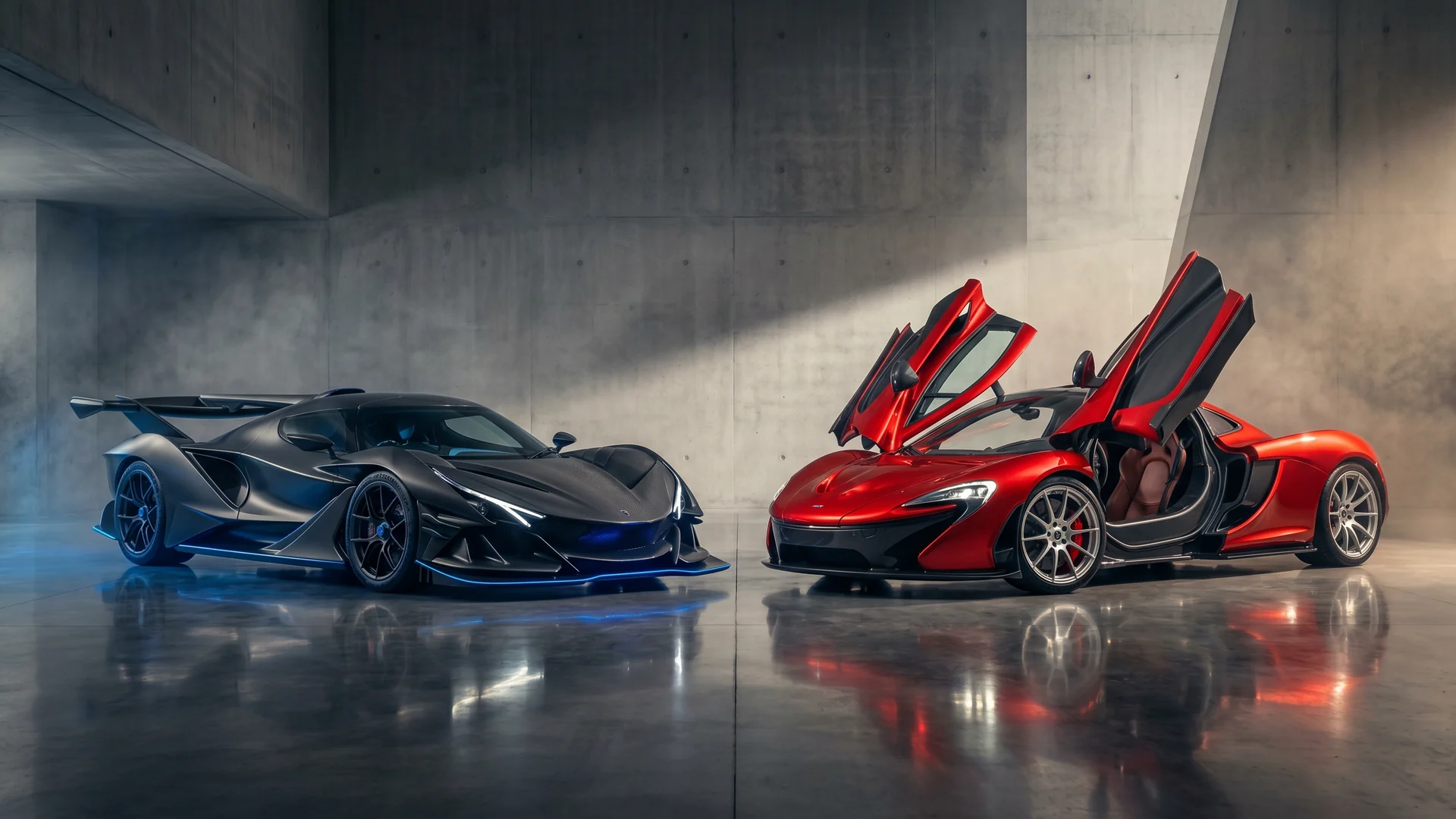
The clearest line between a supercar and a hypercar is production volume: supercars are built in the thousands and sold through dealers, while hypercars are built in the hundreds and allocated by invitation.
Key Takeaways
- The hypercar term entered widespread use in 2013-2014 with the Holy Trinity: the Ferrari LaFerrari, McLaren P1 and Porsche 918 Spyder, all debuting in 2013.
- Production volume is the most objective differentiator: the Ferrari 488 GTB saw about 12,000 units (a supercar) while the LaFerrari was limited to 708 units (a hypercar) allocated by invitation.
- Price brackets offer a rough guide: supercars run roughly $200,000 to $700,000, hypercars start near $1 million and pass $5 million, and megacars exceed $5 million with under 100 units built.
- Modern hypercars routinely exceed 1,500 horsepower, with the Rimac Nevera making 1,914 hp from four electric motors and the Koenigsegg Jesko Absolut producing 1,600 hp on E85 fuel.
- Hypercar hybrid systems are structural and motorsport-derived, like the LaFerrari's F1-derived HY-KERS, whereas supercars tend to add electric motors to a conventional combustion platform.
- Aerodynamic downforce separates the tiers: hypercars target 800 to 1,100-plus kg, with the Aston Martin Valkyrie aiming for over 1,100 kg, while supercars operate in the 200 to 500 kg range.
- Ownership costs scale disproportionately: a LaFerrari's annual service runs roughly $8,000 to $12,000 and insurance on a $3.5 million example costs about $20,000 to $35,000 per year.
🌐 Also available in: Deutsch
Defining the Hypercar Category
The term hypercar entered the automotive lexicon in the early 2010s, popularized by the arrival of what enthusiasts now call the Holy Trinity: the Ferrari LaFerrari, McLaren P1, and Porsche 918 Spyder. These three cars, all debuting in 2013, established the template that defines the category to this day. A hypercar is a limited-production, technology-laden machine that sits a full tier above even the most extreme supercars in performance, price, and exclusivity. Where a supercar might be built in the thousands and sold through conventional dealer networks, a hypercar is built in the hundreds, or dozens, and sold by private invitation to the manufacturer’s most loyal clients. Where a supercar uses largely conventional powertrain technology, a hypercar deploys hybrid systems, active aerodynamics, and materials science derived from contemporary motorsport programs.
The performance threshold has evolved dramatically since 2013. The LaFerrari’s combined 950 horsepower from a 6.3-liter naturally aspirated V12 paired with a Formula 1-derived HY-KERS electric motor was staggering at the time. By 2026, hypercars routinely exceed 1,500 horsepower. The Koenigsegg Jesko Absolut produces 1,600 horsepower on E85 fuel from a twin-turbocharged 5.0-liter V8 driving the rear wheels through Koenigsegg’s 9-speed Light Speed Transmission. The Rimac Nevera delivers 1,914 horsepower from four electric motors, one per wheel, with torque vectoring that can independently control the power delivered to each corner. The Bugatti Tourbillon pairs an all-new naturally aspirated 8.3-liter Cosworth V16 with three electric motors for a combined 1,800 horsepower. The modern hypercar is defined less by any specific power figure than by the radical engineering and financial investment required to achieve it.
Production Numbers: The Most Objective Differentiator
Production volume is the clearest line separating supercars from hypercars. A Ferrari 488 GTB, unequivocally a supercar, saw approximately 12,000 units built across all variants including the GTB coupe, Spider convertible, Pista, and Pista Spider. The Ferrari LaFerrari, unequivocally a hypercar, was limited to 499 coupes plus 209 Aperta spiders for a total of 708 units. The Ferrari SF90 Stradale, despite its 986-horsepower plug-in hybrid powertrain that produces acceleration within striking distance of the LaFerrari, will likely see production exceeding 5,000 units, which firmly classifies it as a supercar despite hypercar-rivaling performance. The production-volume test is elegant because it reflects the manufacturer’s own classification: Ferrari allocated the LaFerrari by invitation to its most loyal customers; the SF90 Stradale is available to any qualified buyer.
This distinction directly affects value, collectability, and ownership experience. Hypercars are sold by invitation only, typically to clients who have purchased multiple new cars from the brand and have a documented history of keeping, not flipping, their vehicles. Ferrari required LaFerrari applicants to own at least five other Ferraris purchased new from an authorized dealer. McLaren’s allocation process for the Speedtail prioritized existing Ultimate Series owners and selected high-profile clients. Porsche selected 918 Spyder buyers based on their history with the brand, their motorsport involvement, and their commitment to driving rather than storing the car. Supercars, by contrast, are available to anyone with the means to pay, though some limited variants like the Ferrari 812 Competizione and Porsche 911 S/T increasingly blur this boundary by requiring purchase history.
Price Brackets as a Working Guide
Price provides a rough but useful delineation between the categories. Modern supercars occupy the $200,000 to $700,000 range. The entry-level supercar segment includes the Porsche 911 Turbo S ($230,000), McLaren Artura ($237,000), and Ferrari Roma Spider ($280,000). The mid-tier includes the Ferrari 296 GTB ($340,000), Lamborghini Huracán replacement ($350,000 estimated), and McLaren 750S ($330,000). The upper supercar tier includes the Ferrari SF90 XX Stradale ($890,000), Lamborghini Revuelto ($608,000 base, $700,000+ with options), and Porsche 911 GT2 RS ($325,000 new, $400,000+ used).
Hypercars begin at approximately $1 million to $1.5 million and extend well past $5 million. The Bugatti Chiron base price was $3 million. The Koenigsegg Jesko starts at $3 million. The Pagani Utopia, arguably straddling the hypercar boundary, carries a $2.5 million base price. The Bugatti Tourbillon is priced at €3.8 million ($4.1 million). The Koenigsegg CC850, limited to 50 units, sold at $3.65 million. Options on these cars can add six figures with ease. Bespoke paint on a Koenigsegg costs $50,000 to $80,000. A full exposed carbon-fiber body, requiring perfect weave alignment across every panel, can exceed $300,000. A fully optioned Chiron Super Sport regularly exceeded $4 million.
Powertrain Technology: Integration vs. Addition
Supercars increasingly use hybrid assistance, but hypercars make hybridization a structural element of the vehicle’s design. The LaFerrari’s HY-KERS system was derived directly from Ferrari’s Formula 1 Kinetic Energy Recovery System program and was integral to the car’s packaging, the battery pack formed part of the floor structure, the electric motor was integrated into the dual-clutch transmission housing, and the entire system was designed to lower the car’s center of gravity. This integration-first philosophy separates hypercar hybrid systems from supercar systems, which tend to add electric motors to an existing combustion platform.
The Mercedes-AMG ONE takes this philosophy to its logical extreme. It uses a genuine Formula 1-derived 1.6-liter turbocharged V6 with a split turbocharger (turbine and compressor separated by a shaft, with an electric motor-generator unit between them to eliminate lag), plus four electric motors, two on the front axle, one on the crankshaft, and one integrated into the turbocharger, producing a combined 1,063 horsepower. The engine revs to 11,000 RPM, idles at 1,200 RPM, and requires a rebuild every 50,000 kilometers (31,000 miles). This is a maintenance regime that no supercar buyer would tolerate, but hypercar buyers accept it as the price of authentic F1 technology on the road.
The Aston Martin Valkyrie, co-developed with Red Bull Racing Advanced Technologies and designed by Adrian Newey, Formula 1’s most successful aerodynamicist, uses a 6.5-liter naturally aspirated Cosworth V12 producing 1,000 horsepower at 10,500 RPM on its own, supplemented by a Rimac-sourced hybrid system for an additional 160 horsepower. Total: 1,160 horsepower. The Valkyrie’s engine is a fully stressed member of the carbon-fiber chassis, there is no rear subframe separating the engine from the passenger cell. This is pure Formula 1 construction philosophy executed in a road-registered vehicle. At approximately $3 million, the Valkyrie represents the most extreme interpretation of the hypercar concept: it prioritizes motorsport authenticity above comfort, usability, or cost.
Aerodynamics: Downforce as the Dividing Line
Aerodynamic performance separates the tiers. Supercars produce meaningful downforce, the Porsche 911 GT3 RS (992) generates 860 kg (1,896 lbs) at 285 km/h (177 mph), the McLaren 750S produces approximately 300 kg (661 lbs) at 250 km/h (155 mph). Hypercars operate in an entirely different league. The McLaren Senna, a track-focused hypercar, generates 800 kg (1,764 lbs) at 250 km/h. The Aston Martin Valkyrie targets over 1,100 kg (2,425 lbs), enough theoretical downforce to drive the car upside-down in a tunnel, a claim that has been a staple of hypercar mythology since the McLaren F1 was first described this way in the 1990s. The Valkyrie’s massive underbody Venturi tunnels generate the majority of this downforce through ground effect, minimizing the need for drag-inducing external wings. The Bugatti Tourbillon deploys a retractable rear wing that doubles as an air brake, with the entire aero package working in concert with the active suspension system to change the vehicle’s aerodynamic balance in real time based on speed, braking force, and cornering load. At 400 km/h (249 mph), the Tourbillon’s aero and suspension systems are making thousands of adjustments per second to maintain stability.
The Blurring Boundary
The distinction between supercar and hypercar has blurred substantially since 2020. The Ferrari SF90 XX Stradale produces 1,016 horsepower, more than the LaFerrari, and generates 530 kg (1,168 lbs) of downforce at 250 km/h. The Lamborghini Revuelto‘s 1,001-horsepower hybrid V12 powertrain would have been unthinkable in a production supercar a decade ago, it exceeds the Aventador SVJ by over 200 horsepower. The McLaren W1, the P1’s successor, produces 1,258 horsepower from a hybridized twin-turbo V8 and McLaren describes it as a supercar, not a hypercar. The most useful modern framework may be a three-tier system: supercars ($200K to $700K, thousands built, available for purchase through dealers), hypercars ($1M to $5M+, hundreds built, invitation-only allocation), and megacars ($5M+, under 100 built, fully bespoke, borderline coachbuilt).
Under this framework, the Bugatti Tourbillon, Koenigsegg Jesko, and Pagani Utopia qualify as hypercars. One-off or near-one-off creations, the Rolls-Royce Boat Tail ($28 million, 3 units), Bugatti La Voiture Noire ($18.7 million, 1 unit), and Pagani Zonda HP Barchetta ($17.5 million, 3 units), occupy the megacar tier. The thresholds of $1 million+ price, 1,000+ horsepower, and fewer than 500 units provide a working definition that captures the spirit of the hypercar category without being overly rigid. As supercar performance continues its relentless upward march, the distinction will continue to fade, and the term hypercar may ultimately come to describe a business model, ultra-limited, invitation-only, million-dollar-plus, rather than a specific performance threshold.
Key Takeaways
- Production numbers are the most objective differentiator: Supercars are built in thousands and sold through dealers. Hypercars are built in hundreds and allocated by invitation. This affects everything from value to collectability.
- Price threshold around $1 million: Supercars cluster from $200K to $700K. Hypercars start near $1M and range past $5M. Megacars, one-offs and ultra-limited coachbuilt commissions, exceed $5M.
- Powertrain integration defines the technology gap: Hypercar hybrid systems are structural, motorsport-derived, and integral to the car’s architecture. Supercar hybrids add electric motors to conventional platforms.
- Aerodynamic downforce separates the tiers clearly: Hypercars target 800 to 1,100+ kg of downforce through ground-effect tunnels and active systems. Supercars operate in the 200 to 500 kg range.
- The line is blurring and may eventually dissolve: The SF90 XX and Revuelto push supercar performance deep into hypercar territory. The term may ultimately describe a business model, not a performance metric.
Historical Context: How We Got Here
The term hypercar has a traceable origin story. While the word appeared occasionally in automotive journalism in the 2000s, it entered widespread usage in 2013-2014 with the simultaneous arrival of the Ferrari LaFerrari, McLaren P1, and Porsche 918 Spyder. These three cars shared a common formula, carbon-fiber monocoque, hybrid-electric powertrain with Formula 1 technology transfer, active aerodynamics, production limited to a few hundred units, and a base price around $1 million, that established the template. Before 2013, the most extreme road cars were called supercars regardless of their performance or price. The Bugatti Veyron (2005, 1,001 hp, $1.7M), the Koenigsegg CCX (2006, 806 hp, $650K), the Ferrari Enzo (2002, 660 hp, $670K), and the Porsche Carrera GT (2004, 612 hp, $448K) were all described as supercars in their contemporary press coverage. With hindsight, the Enzo and Carrera GT are better classified as hypercars, they were built in limited numbers (400 Enzos, 1,270 Carrera GTs), incorporated motorsport-derived technology (the Enzo’s F1-style carbon tub and automated manual transmission, the Carrera GT’s carbon monocoque and inboard pushrod suspension), and were priced dramatically above the supercars of their era. The McLaren F1 (1992-1998, 106 units, 627 hp, $815,000 base price rising to $970,000) is now universally acknowledged as the first hypercar, though the term did not exist during its production run. The F1 established every hypercar convention 20 years before the LaFerrari arrived: carbon-fiber monocoque, central driving position, gold-lined engine bay heat shielding, production limited to barely over 100 units, and a price that was approximately three times the next most expensive supercar. History has been kind to the F1, examples now trade between $15 million and $25 million.
Case Study: Ferrari SF90 Stradale. Supercar or Hypercar?
The Ferrari SF90 Stradale is the ideal case study for the blurred boundary. Its specifications are hypercar-grade: 986 horsepower (more than the LaFerrari), a plug-in hybrid system with three electric motors and all-wheel drive, carbon-fiber construction, and a 0-60 time of 2.0 seconds that matches the LaFerrari. Yet Ferrari classifies the SF90 as a series-production supercar, not a limited hypercar. The distinction is production volume and allocation policy. Ferrari will build thousands of SF90s across all variants (Stradale coupe, Spider, XX Stradale, XX Spider). Any qualified buyer can purchase one. Contrast this with the LaFerrari, which required an invitation, prior ownership of multiple new Ferraris, and a commitment not to flip the car. The SF90 XX Stradale complicates the picture further, limited to 799 coupes and 599 spiders, with 1,016 horsepower and 530 kg of downforce, it occupies a middle ground that defies easy classification. The pragmatic conclusion: the production-volume test remains the most useful differentiator. Cars available to any buyer with funds are supercars. Cars allocated by invitation to brand-loyal collectors are hypercars. By this standard, the SF90 Stradale is a supercar with hypercar performance, and the LaFerrari is a hypercar with a supercar’s usability (relatively speaking). The line is real but fuzzy, and it will grow fuzzier as supercar performance continues its relentless climb.
The Ownership Experience: What Changes When You Move from Supercar to Hypercar
The differences between owning a supercar and owning a hypercar extend far beyond the purchase price and the performance statistics. The ownership experience itself is fundamentally different in ways that prospective buyers should understand before pursuing a hypercar allocation. Service and maintenance costs scale disproportionately. A Ferrari 488’s annual service at a dealer costs $3,500 to $5,000. A LaFerrari’s annual service, which includes the HY-KERS hybrid system inspection, high-voltage battery health check, and the same engine and chassis service as the 488, costs approximately $8,000 to $12,000 per year, more than double the supercar equivalent. The LaFerrari’s battery pack, located low in the chassis behind the seats, has a service life of approximately 10 to 15 years, and replacement cost, when it eventually becomes necessary, is estimated at $70,000 to $120,000. These are costs that supercar owners do not contemplate and that hypercar owners must accept as part of the stewardship of a technological milestone.
Insurance scales similarly. A Ferrari 488 insured for $300,000 agreed value costs $4,000 to $7,000 annually. A LaFerrari insured for $3.5 million costs approximately $20,000 to $35,000 annually, with fewer carriers willing to write the policy. Storage requirements intensify. A hypercar cannot be kept in a standard home garage alongside the family SUV, the value concentration demands climate control, security systems, and often a dedicated collector car storage facility with 24/7 monitoring. Annual storage costs for a climate-controlled, secured facility range from $5,000 to $15,000. Transportation becomes more complex, enclosed transport for a supercar costs $1,500 to $4,000 cross-country; for a hypercar, many owners use dedicated, single-car enclosed transporters with lift-gate loading (to avoid ramp-angle damage to the front splitter) and GPS tracking, at costs of $3,000 to $8,000. The driving experience itself changes, a supercar can be driven to a restaurant, parked in a public lot, and left for two hours while the owner dines. A hypercar attracts a crowd of 20 to 50 people within minutes of parking, and leaving it unattended in a public lot is an act of trust in the universe that many owners are unwilling to extend. The result is that hypercars are driven less frequently, for more curated experiences, and with more logistical overhead than supercars. This is not a criticism, it is the reality of owning an object worth $2 million to $5 million that is also inherently public-facing. Prospective hypercar buyers should budget not just for the purchase price but for the full ecosystem of costs and constraints that accompany hypercar ownership.
The Koenigsegg Factor: A Small Company Competing with Empires
Koenigsegg’s position in the hypercar hierarchy deserves special examination because it represents a unique competitive dynamic. Koenigsegg Automotive AB, based in Ängelholm, Sweden, employs fewer than 500 people. It designs and manufactures its own engines, transmissions, carbon-fiber components, and software in-house. It competes directly with Bugatti, a brand owned by the Volkswagen Group (700,000 employees, €322 billion in annual revenue) and now partnered with Rimac, and with Ferrari (5,000 employees, €6 billion in revenue). Koenigsegg’s survival and success at this competitive scale is an anomaly in the automotive industry. The company’s strategy is to produce fewer than 50 cars per year, the Jesko production run is 125 units over approximately four years, at prices exceeding $3 million, with waiting lists that extend years into the future. Every car is sold before production begins. There is no inventory, no dealer network (Koenigsegg sells direct to clients through a handful of international showrooms), and no discounting. The business model is the polar opposite of the volume-supercar approach that has caused McLaren’s depreciation struggles. Koenigsegg proves that extreme scarcity, engineering in-house, and a direct-to-client sales model can sustain a hypercar manufacturer at the very top of the market, even without the corporate backing of a Volkswagen or a Ferrari.
Frequently Asked Questions (FAQ)
What is the difference between a hypercar and a supercar?
Production volume is the clearest difference: supercars are built in the thousands and sold through dealer networks, while hypercars are built in the hundreds or dozens and allocated by private invitation. Hypercars also sit a tier above in price, performance and exclusivity, deploying structural hybrid systems, active aerodynamics and motorsport-derived materials.
When did the term hypercar first become popular?
The term entered widespread usage in 2013-2014 with the simultaneous arrival of the Ferrari LaFerrari, McLaren P1 and Porsche 918 Spyder, all debuting in 2013. These three cars, known as the Holy Trinity, established the carbon-fiber, hybrid-electric, active-aero template that defines the category to this day.
Why is the Ferrari SF90 Stradale considered a supercar and not a hypercar?
Despite its 986-horsepower plug-in hybrid powertrain and a 0-60 time of 2.0 seconds that matches the LaFerrari, the SF90 Stradale is classified as a supercar because of production volume and allocation. Ferrari will build thousands across all variants, and any qualified buyer can purchase one, unlike the invitation-only LaFerrari.
How much do hypercars cost compared to supercars?
Modern supercars occupy the $200,000 to $700,000 range, while hypercars begin around $1 million to $1.5 million and extend well past $5 million. The Bugatti Chiron started at $3 million and the Koenigsegg Jesko at $3 million. Options can add six figures, with bespoke Koenigsegg paint costing $50,000 to $80,000.
Which hypercar makes the most horsepower?
Among the cars covered, the Rimac Nevera delivers the most at 1,914 horsepower from four electric motors, one per wheel, with torque vectoring controlling power to each corner. The Bugatti Tourbillon makes 1,800 hp from a V16 plus three electric motors, and the Koenigsegg Jesko Absolut produces 1,600 hp on E85 fuel.
What is considered the first hypercar?
The McLaren F1, produced 1992-1998 in 106 units with 627 horsepower, is now universally acknowledged as the first hypercar, though the term did not exist during its production run. It established every hypercar convention, including a carbon-fiber monocoque and central driving position. Examples now trade between $15 million and $25 million.
How much does it cost to own a hypercar like the LaFerrari?
Hypercar ownership costs scale disproportionately. A LaFerrari's annual service runs approximately $8,000 to $12,000, insurance on a $3.5 million example costs about $20,000 to $35,000 yearly, and climate-controlled secured storage adds $5,000 to $15,000. Its battery pack may eventually need replacement at an estimated $70,000 to $120,000.
What is a megacar and how does it differ from a hypercar?
A megacar is the top tier above hypercars, priced over $5 million with fewer than 100 units built, fully bespoke and borderline coachbuilt. Examples include the Rolls-Royce Boat Tail at $28 million in three units and the Bugatti La Voiture Noire at $18.7 million as a single unit, while the Tourbillon and Jesko remain hypercars.
What is the clearest difference between a supercar and a hypercar?
How do price brackets compare across the tiers?
How much power do modern hypercars produce?
More from Magazine
Future of Supercars – Electric Revolution and Beyond
The future of supercars: Ferrari’s 2025 electric flagship, Porsche’s synthetic eFuel, Rimac’s record-breaking EVs and why the V12 su…
Supercar Technology Innovation Guide – The Future of Performance
Supercar technology guide: how carbon-fiber tubs, active aero, hybrids, dual-clutch gearboxes and software shape performance in the McLaren, Ferrari a…
Supercar Rental Worldwide Guide – Drive Your Dream Car Today
Supercar rental guide: daily rates from $500 to $20,000+, security deposits, insurance rules, top locations worldwide, and track packages explained.…