Supercar Tuning Performance Guide: Extracting Maximum Power
Supercar tuning guide: how a Ferrari 488, Porsche 911 Turbo S or McLaren 720S gains power, with ECU, exhaust and turbo costs plus warranty and resale risks.…
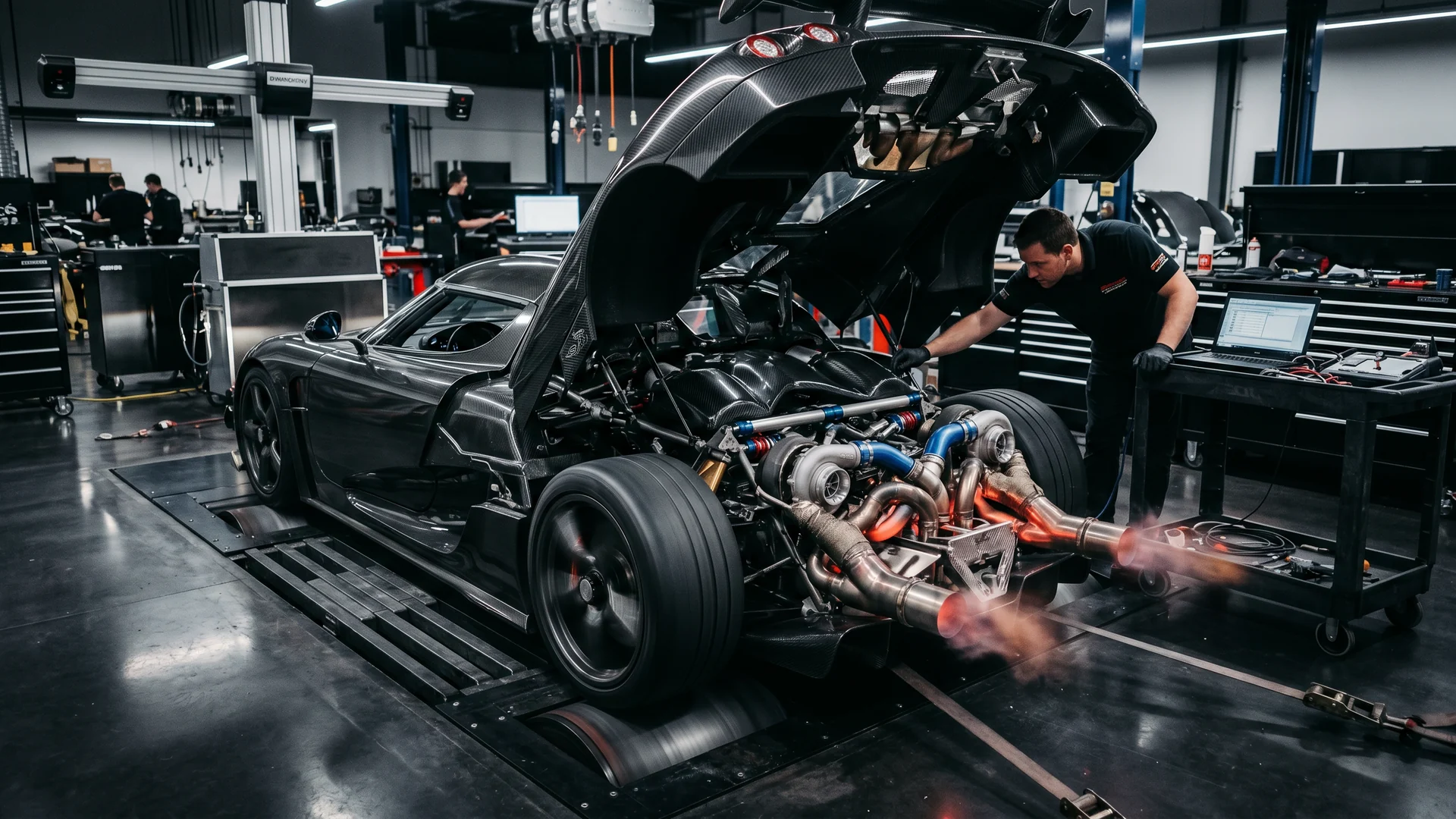
Tuning a turbocharged supercar like the Ferrari 488 GTB with a Stage 1 ECU remap adds 60 to 90 horsepower for 3,000 to 7,000 dollars, but warranty and resale value almost always suffer.
Key Takeaways
- A Stage 1 ECU remap with no hardware changes lifts the Ferrari 488 GTB from 661 hp to 720-750 hp and the Porsche 911 Turbo S (992) from 640 hp to 720-760 hp, costing roughly 2,500 to 7,000 dollars.
- Naturally aspirated supercars respond poorly: a Ferrari 458 Italia (562 hp) gains only 20-30 hp, about 5 percent, for a 10,000 to 15,000 dollar investment, making the cost per horsepower prohibitive.
- Full turbocharger upgrades can push a Ferrari 488 to 850-900+ hp, while a comprehensive Stage 3 build covering turbos, fuel system and transmission reaches 50,000 to 80,000 dollars.
- Manufacturers detect ECU tampering through flash counters via tools like Ferrari's Leonardo, Lamborghini's ODIS and McLaren's MDS, so powertrain warranty claims on modified cars are denied.
- Catalytic converter deletion violates the US Clean Air Act with EPA fines up to 4,800 dollars per violation, fails inspection in 34 states, and is impractical in Europe under TÜV and emission-zone rules.
- Manthey-Racing, majority-owned by Porsche AG since 2013, sells warranty-preserving packages through Porsche dealers; its 911 GT3 MR laps the Nürburgring in 6:49 versus 6:55 for the stock 992 GT3.
- Underground Racing's twin-turbo Lamborghini Huracán builds start at 50,000 to 80,000 dollars and produce 800-1,000 wheel horsepower, with built-engine Stage 3 cars reaching 1,500 to 2,500+ wheel horsepower.
- Exhaust, forged wheels and suspension are the safest, reversible modifications: a titanium exhaust costs 8,000 to 30,000 dollars and forged wheels 8,000 to 15,000 dollars without jeopardizing the powertrain warranty.
🌐 Also available in: Deutsch
The Case For and Against Tuning a Supercar
Tuning a supercar is one of the most polarizing subjects in the enthusiast community. On one side are the purists who argue that a manufacturer’s engineering organization, deploying hundreds of millions of dollars in research and development, thousands of hours of multi-continent development driving, and full warranty and durability testing, has already extracted the optimal balance of performance, reliability, and drivability. On the other side are owners who recognize that the factory calibration is a compromise designed to accommodate 91-octane California fuel, European Union noise regulations, emissions compliance across dozens of jurisdictions, and an owner demographic that spans from expert drivers to individuals who will never exceed 4,000 RPM. Both perspectives have substantial merit, and the right approach depends entirely on the specific car, the specific modifications under consideration, and the owner’s tolerance for risk, both financial risk (warranty voiding, diminished resale value) and mechanical risk (component failure at high speed).
The modern turbocharged supercar is the most fertile ground for tuning. Engines like the Ferrari F154 3.9-liter twin-turbo V8, the McLaren M840T 4.0-liter twin-turbo V8, and the Porsche EA9A2 3.8-liter twin-turbo flat-six are calibrated with substantial safety margins in boost pressure, fuel delivery, and ignition timing. The factory calibration must account for worst-case scenarios: 91-octane fuel at high altitude on a 40-degree-Celsius day with a neglected air filter and oil that has exceeded its service interval. A tuner calibrating for a specific owner who commits to 93+ octane fuel, 3,000-mile oil changes, and mechanical sympathy can extract substantial additional power while operating well within the engine’s mechanical limits.
ECU Tuning: The Gateway Modification
An ECU (Engine Control Unit) remap is the most common and cost-effective supercar modification. On a turbocharged engine, the tuner adjusts boost pressure targets, wastegate duty cycle, fuel delivery maps, ignition timing advance, and throttle mapping to increase power. A Ferrari 488 GTB leaves the Maranello assembly line with 661 horsepower at 8,000 RPM and 760 Nm (561 lb-ft) of torque. A Stage 1 ECU remap, no physical hardware changes whatsoever, can increase output to 720 to 750 horsepower, a gain of 60 to 90 horsepower. The torque increase is often more dramatic, rising from 760 Nm to approximately 830 to 870 Nm, which transforms the car’s mid-range acceleration. The cost for a Stage 1 tune is $3,000 to $7,000. On modern Ferraris with encrypted ECU security (2019 and later models), the ECU must be physically removed from the car and bench-unlocked before it can be programmed, which adds $1,000 to $2,000 in labor to the tuning cost. Once unlocked, the ECU can be re-flashed through the OBD-II diagnostic port.
On a Porsche 911 Turbo S (992), which produces 640 horsepower from its 3.8-liter twin-turbo flat-six, a Stage 1 tune alone yields 720 to 760 horsepower for $2,500 to $4,500. Porsche engines are legendary for their overhead capacity, the Turbo S engine shares its basic architecture with the GT2 RS engine that produces 700 horsepower in stock form, meaning the 640-horsepower Turbo S calibration is deeply conservative. A McLaren 720S, producing 710 horsepower stock, can reach 800 to 820 horsepower with a tune alone, though McLaren ECUs are among the most difficult to access, the process often requires shipping the ECU to a specialist who can defeat the encryption on a bench harness.
The critical distinction in the tuning industry is between responsible tuners who operate within the engine’s known mechanical limits and dyno-queen tuners who chase peak horsepower figures at the expense of reliability. A responsible tuner provides before-and-after dynamometer charts showing air-fuel ratio throughout the RPM range, boost pressure curve, and ignition timing. They conduct road-test data-logging to verify that the calibration works correctly under real-world thermal and load conditions. They explain what they changed and why. A tuner who cannot or will not explain their calibration philosophy in technical detail, or who refuses to provide after-sales support, should be avoided.
Exhaust Systems: Sound and Flow
An aftermarket exhaust system is the most popular hardware modification. Factory supercar exhausts are extraordinarily expensive to produce because of the materials required, titanium, Inconel (a nickel-chromium superalloy), and high-grade stainless steel, and because they must meet noise regulations in dozens of jurisdictions while still producing an emotionally satisfying sound. The Ferrari 488’s factory exhaust includes electronically controlled bypass valves that open under load to reduce backpressure and increase volume. The system works well, but it is compromised by the particulate filters and catalytic converters necessary for emissions compliance.
A full aftermarket exhaust from Novitec, Capristo, or Akrapovič transforms the car’s auditory character. A full titanium system with high-flow or cat-less downpipes, X-pipe or H-pipe center section, and valved mufflers reduces backpressure, decreases weight by 10 to 20 kg (22 to 44 lbs), and increases power by 20 to 40 horsepower when combined with ECU tuning optimized for the increased exhaust flow. The cost ranges from $8,000 to $20,000 for a full titanium valved system. Inconel systems, which use the same material as Formula 1 exhaust manifolds, push the cost to $15,000 to $30,000 and are typically offered only for the highest-tier hypercars.
Catalytic converter deletion is legally fraught. In the United States, removing or tampering with catalytic converters violates federal EPA regulations under the Clean Air Act, regardless of state emissions testing requirements. The EPA can levy fines of up to $4,800 per violation against shops that remove catalysts and, in enforcement actions, against vehicle owners. Cars with deleted catalysts cannot pass emissions inspections in the 34 states that require them. In Europe, noise and emissions regulations, particularly in Germany (TÜV), Switzerland, and urban low-emission zones in the UK, make catalyst removal impractical for street use. The compromise solution is sport catalytic converters: high-flow units with reduced cell density (typically 200 cells per square inch versus the factory 400 to 600 CPSI) that improve exhaust flow while retaining enough catalytic material to pass emissions testing. Sport cats add $3,000 to $6,000 to the exhaust system cost.
Turbocharger Upgrades: The Next Performance Tier
For owners seeking maximum power, turbocharger upgrades unlock the next level. The Ferrari 488’s factory IHI turbochargers are sized for responsive low-end torque and a broad, linear power band. Aftermarket turbo upgrades, typically involving larger compressor and turbine wheels machined into the factory turbocharger housings, or complete turbocharger replacements, shift the power band upward, trading some low-RPM responsiveness for dramatically more top-end power. A 488 with upgraded turbos, a full exhaust system, high-flow air filters, and an optimized ECU calibration can produce 850 to 900+ horsepower, a gain of 190 to 240 horsepower over stock. The cost for turbochargers alone is $15,000 to $30,000, plus installation and tuning.
At this power level, supporting modifications become necessary. The factory clutch packs in the dual-clutch transmission may not reliably hold the additional torque. The fuel system, particularly the high-pressure fuel pump and injectors, may reach their maximum delivery capacity. The intercoolers may be inadequate for sustained high-boost operation on a track. A comprehensive “Stage 3” build that addresses the turbochargers, exhaust, intake, intercoolers, fuel system, and transmission calibration can reach $50,000 to $80,000. The resulting car will be monumentally fast in a straight line, but it will almost certainly be less pleasant to drive on the street, increased turbo lag, a louder and more resonant exhaust note, and a more aggressive power delivery that demands respect.
For naturally aspirated supercars, the tuning equation is fundamentally different. A Ferrari 458 Italia (562 hp stock) might gain 20 to 30 horsepower from a combination of ECU tune, aftermarket exhaust, and aftermarket intake, approximately a 5% increase for an investment of $10,000 to $15,000. The cost per horsepower is punishing, and the driving experience does not transform in the way a turbocharged car’s experience does. This is why naturally aspirated supercar owners generally focus on chassis, suspension, and aesthetic modifications rather than chasing power gains that the engine architecture simply cannot deliver.
Reputable Tuners by Brand
Ferrari: Novitec Group
Novitec Group, based in Germany, is the largest and most established Ferrari tuner globally. Its catalog spans the 296 GTB, SF90, F8 Tributo, 812 Superfast, Roma, and Portofino. Novitec’s approach is conservative by aftermarket standards, power claims are independently verified, exhaust systems are TÜV-approved for the demanding German market, and the company maintains cordial relationships with Ferrari dealers who occasionally refer customers seeking personalization beyond the factory’s options list. Novitec’s full conversions, engine tuning, exhaust, aerodynamic body kits, suspension lowering modules, forged wheels, and interior retrimming, are turn-key, installed at Novitec’s facility, and backed by a Novitec warranty that supplements (without replacing) the factory coverage. Costs range from $15,000 for a basic ECU and exhaust package to $100,000+ for a complete conversion with forged wheels and full aero kit.
Lamborghini: Novitec Torado, Mansory, Underground Racing
Novitec Torado (Novitec’s Lamborghini division) and Mansory are the primary European Lamborghini tuners, offering exhaust, ECU, suspension, and aero modifications for the Huracán, Aventador, Revuelto, and Urus. Underground Racing, based in Charlotte, North Carolina, deserves separate discussion. Their twin-turbo Lamborghini conversions are among the most extreme automotive modifications available anywhere. A twin-turbo Huracán Stage 1 package, twin turbochargers, intercoolers, exhaust, ECU, fuel system, starts at $50,000 to $80,000 and produces 800 to 1,000 wheel horsepower on the stock engine internals. Stage 3 and beyond, with built engines featuring forged pistons, connecting rods, and upgraded valvetrain components, can produce 1,500 to 2,500+ wheel horsepower. These cars hold numerous half-mile and standing-mile speed records globally. Underground Racing is transparent about the trade-offs: these are purpose-built speed machines, not daily drivers, and they require careful maintenance and a driver with genuine skill.
Porsche: Manthey-Racing
Manthey-Racing, majority-owned by Porsche AG since 2013, occupies a unique position. It is both an independent tuning company and effectively Porsche’s in-house motorsport and performance division. Manthey’s approach is Nürburgring-focused chassis development. Its 911 GT3 MR package. KW coilover suspension with Manthey-specific valving, upgraded brake pads with stainless-steel lines, aerodynamic enhancements including a larger rear wing and front splitter, and lightweight forged wheels, produces a car that laps the Nürburgring Nordschleife in 6 minutes 49 seconds, compared to 6:55 for the stock 992 GT3. The six-second improvement on a 12.9-mile circuit is enormous. Critically, Manthey packages are sold through Porsche dealers and do not void the factory warranty. This arrangement, a manufacturer-approved tuning package with full warranty coverage, is unique in the industry. Manthey kits range from $35,000 to $75,000 depending on the model. TechArt and APR are the leading aftermarket (non-warranty-preserving) Porsche tuners.
McLaren: M Engineering, Novitec
M Engineering, based in the United States, is the leading McLaren tuning specialist. Their Stage 2 package for the 720S, ECU tune, high-flow downpipes, and upgraded intercoolers, produces 850 to 900 horsepower and costs $20,000 to $35,000. M Engineering has invested heavily in defeating McLaren’s ECU encryption, which is among the most sophisticated in the industry, and their calibrations are widely respected within the McLaren owner community. Novitec also offers McLaren tuning packages with similar power claims and TÜV certification.
Warranty, Resale, and Risk Management
Any modification that increases engine output beyond factory specifications will result in denial of warranty coverage for the engine, transmission, and drivetrain components if the manufacturer can demonstrate a causal link between the modification and the failure. In practice, the burden of proof under the Magnuson-Moss Warranty Act theoretically protects consumers, but Ferrari, Lamborghini, and McLaren are aggressive in their warranty enforcement. Their dealer-installed diagnostic tools (Ferrari’s Leonardo system, Lamborghini’s ODIS, McLaren’s MDS) can detect ECU tampering even if the modified calibration has been reverted to stock before a service visit. The ECU records “flash counters” that increment each time the ECU is programmed. A car with a flash count that does not match the factory service records is flagged.
The practical strategy employed by most owners is to modify cars that are out of their factory warranty period, accepting the risk that a major mechanical failure will be an out-of-pocket expense. Alternatively, owners who cannot accept this risk stay with stock calibrations, use manufacturer-approved upgrades exclusively (Manthey for Porsche, MSO for McLaren), or purchase aftermarket warranty coverage that explicitly covers modified vehicles, a rare and expensive insurance product available from a handful of specialty underwriters.
Resale value overwhelmingly suffers from modifications. A modified supercar sells for significantly less than a stock equivalent in nearly all cases. The buyer pool for a modified car is a small fraction of the pool for a stock car. A Novitec-converted Ferrari may retain 40% to 60% of the modification cost at resale to the right buyer. A car with an unknown tuner’s ECU remap and a cat-less exhaust is effectively unsellable through any franchised dealer and will trade exclusively in the private-party market at a steep discount. If resale value is a priority, retain all stock components, return the car to stock configuration before listing it for sale, and sell the aftermarket parts separately. Stock parts, particularly exhaust systems, wheels, and OEM carbon-fiber components, have strong resale value in the enthusiast community and can recover 30% to 50% of the aftermarket modification cost.
Key Takeaways
- Turbocharged engines respond dramatically to ECU tuning: Ferrari 488 GTB gains 60-90 hp (Stage 1, $3K-$7K). 911 Turbo S gains 80-120 hp ($2.5K-$4.5K). Naturally aspirated engines gain less than 5%, the cost per horsepower is prohibitive.
- Novitec, Manthey, Underground Racing, and M Engineering are the premier tuners: Novitec for comprehensive, TÜV-approved European conversions. Manthey for warranty-preserving Porsche chassis development. Underground Racing for extreme Lamborghini twin-turbo builds (up to 2,500+ hp).
- Warranty implications are severe and effectively irreversible: Manufacturers detect ECU tampering via flash counters. Powertrain warranty claims will be denied. Out-of-warranty cars are the safer tuning canvas.
- Resale value almost always suffers: Modified cars sell for less than stock equivalents. Novitec and Manthey retain some brand equity. Unknown-tuner cars are nearly unsellable through dealers. Keep stock parts; revert before selling.
- Exhaust, wheels, and suspension are the safest starting modifications: A titanium exhaust ($8K-$30K) transforms the sound. Forged wheels ($8K-$15K) reduce unsprung weight. Aftermarket lift systems ($6K-$12K) make lowered cars practical. These modifications are reversible and do not jeopardize the powertrain warranty.
Wheels, Tires, and Unsprung Weight
Aftermarket wheels are simultaneously the most popular aesthetic modification and one of the most technically significant performance modifications available. The factory wheels on most supercars are cast aluminum or flow-formed, manufacturing processes that are cost-effective at production scale but leave weight on the table. Forged monoblock wheels from HRE, ANRKY, Vossen Forged, BBS, and Forgeline are machined from a single billet of 6061-T6 aluminum under immense pressure, producing a grain structure that aligns with the wheel’s shape and provides higher strength with less material. Weight savings versus factory cast wheels range from 2 to 5 kg (4.4 to 11 lbs) per corner. This is unsprung, rotating mass, the most impactful type of weight reduction because it improves ride quality (less mass for the suspension to control), steering response (less rotational inertia to overcome when turning the wheels), and acceleration (less rotating mass to accelerate). A set of custom forged wheels costs $8,000 to $15,000 with appropriate high-performance tires. The visual impact is enormous, a supercar on properly fitted forged wheels with aggressive offset and concavity has a stance and presence that the factory setup cannot match.
Safety considerations for aftermarket wheels are not optional. The wheels must be load-rated for the vehicle’s weight and top speed. A Ferrari 296 GTB reaches 330 km/h (205 mph). A wheel that fails at that speed is a catastrophic event with potentially fatal consequences. All reputable forged wheel manufacturers, HRE, BBS, Forgeline, subject their wheels to TÜV or SAE J2530 testing that certifies load capacity and fatigue life. Verify that the wheels you are considering carry these certifications before purchasing. The wheels must also have the correct center bore (or hub-centric rings) and bolt pattern for your specific car. Center-lock wheels, used on Porsche GT cars, Ferraris, and Lamborghinis, are a specialized market with fewer aftermarket options due to the complexity and safety implications of the center-lock mechanism. Only a handful of manufacturers (BBS, HRE, Forgeline) offer center-lock wheels, and they are significantly more expensive, $3,000 to $5,000 per wheel versus $1,500 to $2,500 for a five-lug forged wheel. Tire selection is equally critical. The tires must have the correct load index and speed rating for the vehicle. A tire with a Y speed rating (300 km/h / 186 mph) is inadequate for a car that reaches 330 km/h. The correct rating is (Y), parentheses indicate the tire has been tested above 300 km/h to a specific higher speed. Michelin, Pirelli, and Goodyear all produce (Y)-rated tires in the sizes required by modern supercars.
Frequently Asked Questions (FAQ)
How much horsepower does a Stage 1 ECU tune add to a Ferrari 488 GTB?
A Stage 1 ECU remap raises the Ferrari 488 GTB from 661 horsepower to 720-750 horsepower, a gain of 60 to 90 horsepower with no physical hardware changes. Torque also climbs from 760 Nm to roughly 830-870 Nm. The tune costs 3,000 to 7,000 dollars, plus 1,000 to 2,000 dollars to bench-unlock encrypted 2019-and-later ECUs.
Why do tuners say naturally aspirated supercars are not worth tuning?
Naturally aspirated engines lack the boost, fuel and timing safety margins that turbocharged engines hold in reserve. A Ferrari 458 Italia (562 hp) gains only 20-30 horsepower, about 5 percent, from a combined ECU tune, exhaust and intake costing 10,000 to 15,000 dollars. The cost per horsepower is punishing, so owners focus on chassis, suspension and aesthetics instead.
Does tuning a Ferrari or McLaren void the factory warranty?
Yes, in nearly all cases. Any modification raising engine output beyond factory specification leads to denied warranty claims for the engine, transmission and drivetrain. Ferrari, Lamborghini and McLaren enforce aggressively, using diagnostic tools like Leonardo, ODIS and MDS that read ECU flash counters to detect tampering even after a car is reverted to stock calibration.
Is the Porsche Manthey-Racing package warranty-safe for a 911?
Yes. Manthey-Racing has been majority-owned by Porsche AG since 2013, and its packages are sold through Porsche dealers and do not void the factory warranty. The 911 GT3 MR package adds KW coilovers, upgraded brakes, aerodynamics and forged wheels, lapping the Nürburgring in 6:49 versus 6:55 stock. Manthey kits range from 35,000 to 75,000 dollars.
Is deleting the catalytic converter on a supercar legal in the United States?
No. Removing or tampering with catalytic converters violates federal EPA regulations under the Clean Air Act, regardless of state testing rules. The EPA can fine up to 4,800 dollars per violation, and cars with deleted catalysts fail inspection in the 34 states that require it. The legal compromise is sport catalytic converters with reduced cell density that still pass emissions.
How much power can Underground Racing extract from a twin-turbo Lamborghini Huracán?
Underground Racing, based in Charlotte, North Carolina, builds among the most extreme conversions available. A twin-turbo Huracán Stage 1 package starts at 50,000 to 80,000 dollars and produces 800 to 1,000 wheel horsepower on stock internals. Stage 3 builds with forged pistons and rods can reach 1,500 to 2,500+ wheel horsepower, holding numerous half-mile and standing-mile records.
How much does tuning reduce a supercar's resale value?
Resale value overwhelmingly suffers, since the buyer pool for a modified car is a small fraction of the stock-car pool. A Novitec-converted Ferrari may retain only 40 to 60 percent of the modification cost. A car with an unknown tuner's remap and cat-less exhaust is nearly unsellable through franchised dealers. Keeping stock parts and reverting before sale protects value.
What are the safest first modifications for a supercar?
Exhaust, wheels and suspension are the safest starting points because they are reversible and do not jeopardize the powertrain warranty. A titanium exhaust costs 8,000 to 30,000 dollars and transforms the sound, forged wheels run 8,000 to 15,000 dollars and cut unsprung weight by 2 to 5 kg per corner, and aftermarket lift systems cost 6,000 to 12,000 dollars.
More from Motorsport
Future of Supercars – Electric Revolution and Beyond
The future of supercars: Ferrari’s 2025 electric flagship, Porsche’s synthetic eFuel, Rimac’s record-breaking EVs and why the V12 su…
Supercar Insurance Complete Guide – Protecting Your Investment
Supercar insurance guide: why standard policies fail, how Agreed Value works, top carriers Hagerty, Chubb, Grundy, PURE, plus track, storage and broke…
Supercar Technology Innovation Guide – The Future of Performance
Supercar technology guide: how carbon-fiber tubs, active aero, hybrids, dual-clutch gearboxes and software shape performance in the McLaren, Ferrari a…