Supercar Maintenance Complete Guide: What Every Owner Must Know
Supercar maintenance guide: real annual costs by brand, from $5,000 to $25,000, plus tires, carbon-ceramic brakes, major services, storage and warranty advice.…
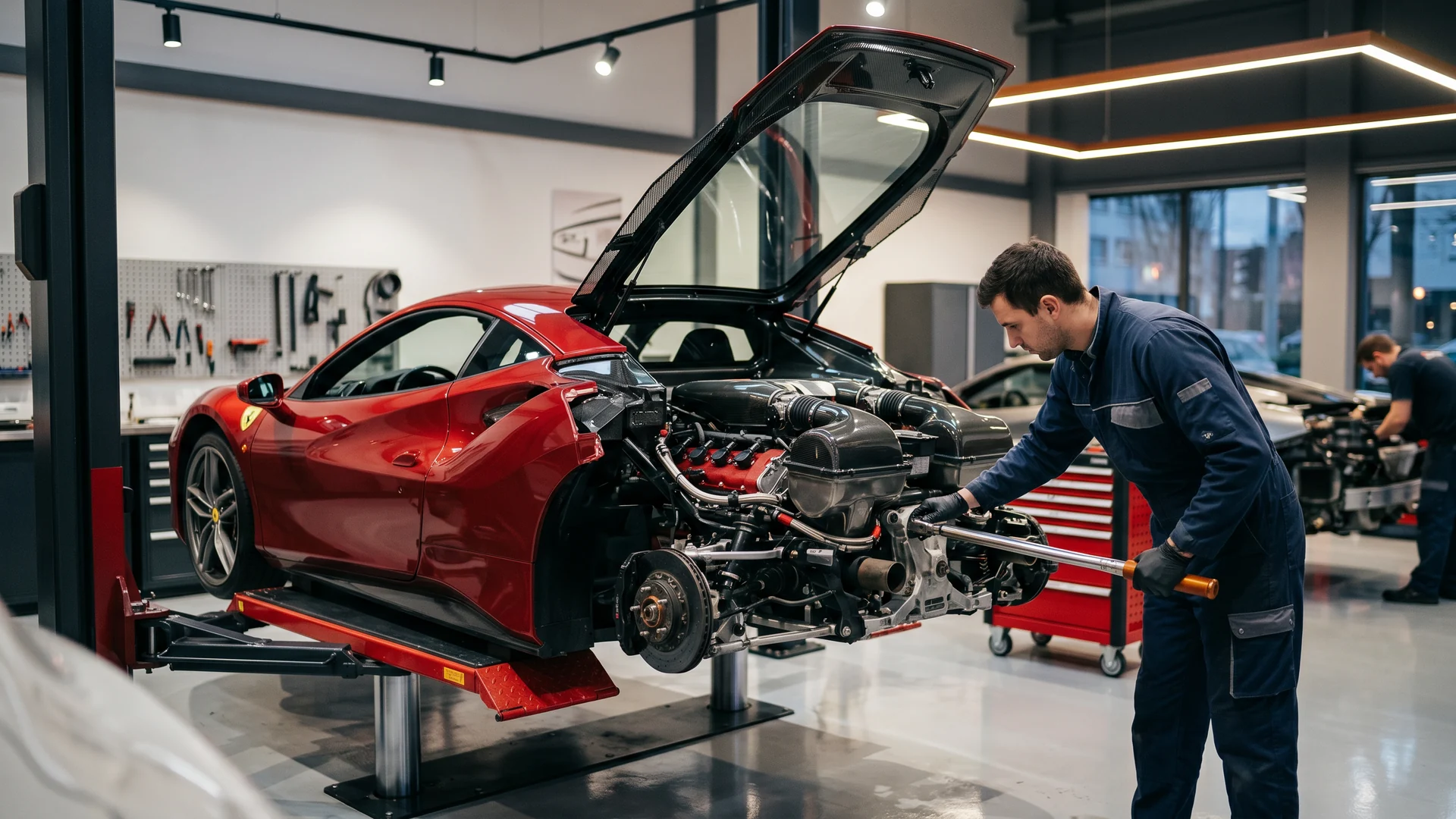
Annual supercar maintenance, excluding fuel and insurance, typically runs $5,000 to $25,000 for a car driven 3,000 to 5,000 miles per year, varying by brand and whether you use a dealer or specialist.
Key Takeaways
- Annual service ranges by brand: a Ferrari 488 GTB costs about $3,500 to $5,000, a Lamborghini Huracan $2,500 to $4,000, a McLaren 720S $2,000 to $3,500, and a Porsche 911 GT3 just $1,200 to $2,000.
- Tires are the largest consumable: a Porsche 911 GT3 RS set runs $2,200 to $2,600, while Lamborghini Aventador SVJ Pirelli P Zero Trofeo R sets cost $4,000 to $5,500 and the McLaren Senna's bespoke MC1 tires roughly $5,000.
- ZR-rated supercar tires, certified for sustained speeds above 240 km/h (149 mph), generally cannot be plugged or patched, so any tread puncture mandates full replacement.
- Carbon-ceramic rotor replacement is financially devastating, costing roughly $25,000 to $35,000 for a Ferrari 488 set, while iron conversion kits from Girodisc or Surface Transforms run $4,000 to $6,000 for track use.
- Major scheduled services dwarf annual costs: the Ferrari F355 engine-out belt service runs $8,000 to $12,000 every 3 to 5 years, and the Murcielago's engine-out timing-chain service costs $10,000 to $15,000.
- Every supercar needs a battery tender like a CTEK ($80 to $150) connected whenever it sits over a week, since a dead battery can lock owners out of cars with electric door or frunk releases.
- Independent specialists charge $150 to $225 per hour versus $250 to $350 at dealers, cutting bills 30% to 50%, but must own the factory diagnostic software such as Ferrari's Leonardo system.
🌐 Also available in: Deutsch
Annual Maintenance Costs by Brand
Supercar maintenance is not an afterthought: it is a significant annual line item that catches many first-time buyers off guard. Annual running costs, excluding fuel and insurance, typically range from $5,000 to $25,000 for a car driven 3,000 to 5,000 miles per year. The spread depends heavily on the brand, the model’s age and complexity, and whether you use an authorized dealer or an independent specialist. Understanding these costs before you buy prevents the unpleasant surprise of a five-figure service bill arriving six months after taking delivery.
A Ferrari 488 GTB driven 3,000 miles annually will cost approximately $3,500 to $5,000 for annual service at a Ferrari dealer. This includes an oil change, which requires 10 to 12 liters of Shell Helix Ultra or equivalent full-synthetic oil meeting Ferrari’s proprietary specification, at $15 to $25 per liter, a full diagnostic scan, brake fluid flush, pollen filter replacement, and a comprehensive multi-point inspection of every system. At roughly the five-year mark, the major service adds spark plug replacement for all eight cylinders, accessory belt replacement, and a deeper inspection of the timing chain system, adding $3,000 to $8,000 depending on findings. Ferrari’s Genuine Maintenance program covers the first seven years of a new car’s routine service for an upfront payment of approximately $7,000 to $9,000, which is excellent value if you intend to keep the car and drive it regularly.
Lamborghini annual service on a Huracán costs $2,500 to $4,000 at an authorized dealer. The Aventador, with its V12 engine and more complex all-wheel-drive system, pushes that to $4,000 to $7,000 per year. The Aventador’s Independent Shifting Rod (ISR) single-clutch automated manual transmission is mechanically simpler than a dual-clutch unit but harder on clutch friction material. Clutch replacement is required between 15,000 and 30,000 miles at a cost of $10,000 to $15,000, with occasional reports of early failures at under 10,000 miles in cars subjected to repeated hard launches. The Huracán’s dual-clutch transmission is dramatically more durable, with clutch packs typically lasting 60,000 to 80,000 miles before replacement at $8,000 to $12,000.
McLaren service intervals are annual or every 10,000 miles, whichever comes first. A standard annual service on a 720S costs $2,000 to $3,500. However, McLarens have earned a reputation for niggling electronic and hydraulic issues that inflate ownership costs beyond the scheduled service items. The active suspension accumulators, nitrogen-filled spherical reservoirs that provide spring and damping force, degrade over time and require replacement every 4 to 6 years at a cost of $3,000 to $5,000 per axle. The hydraulic pump that operates the dihedral doors can fail, with replacement costing $2,500 to $4,000. The IRIS infotainment system’s touchscreen is prone to delamination on earlier cars and the replacement unit is a $5,000 to $8,000 part. These are not scheduled maintenance items, but they occur frequently enough in the McLaren community that owners should budget for them proactively.
Porsche GT products are relatively economical to maintain. An annual service on a 911 GT3 costs $1,200 to $2,000. The GT3’s 4.0-liter naturally aspirated flat-six is famously robust. Porsche’s motorsport-derived engines are over-engineered for road use. The Achilles heel is the center-lock wheel system. Center-lock hubs require a specialized torque wrench capable of delivering 600 Nm (443 lb-ft) of torque, plus a specific greasing procedure on the hub face. Improper installation can lead to catastrophic wheel detachment, a risk that is far from theoretical, as several incidents have been documented. Dealer wheel removal and installation runs $200 to $400 per visit, and it is strongly recommended that center-lock maintenance be performed exclusively by Porsche dealers or certified Porsche specialists. Attempting it yourself without the correct tools and training is gambling with your life.
Tires: The Largest Consumable Cost
Tires are the most frequently replaced high-cost consumable on any supercar. A set of Michelin Pilot Sport Cup 2 tires for a Porsche 911 GT3 RS in 325/30R21 rear and 265/35R20 front sizes costs approximately $2,200 to $2,600 mounted and balanced. These tires last 3,000 to 8,000 miles on the street and as few as 500 to 1,000 track miles. On a Lamborghini Aventador SVJ, the Pirelli P Zero Trofeo R tires in 355/25R21 rear sizing cost $4,000 to $5,500 per set and can be consumed in a single aggressive track weekend. The McLaren Senna’s bespoke Pirelli P Zero Trofeo R MC1 tires run approximately $5,000 per set and are specific to that model, limiting supply and making roadside replacements essentially impossible without advance planning.
Supercar tires cannot be repaired with plugs or patches in most cases due to the ZR speed rating, which certifies the tire for sustained speeds above 240 km/h (149 mph). Any puncture within the tread area that would be safely repairable on a normal car mandates complete tire replacement on a supercar, because a repaired tire is no longer rated for its original speed certification. Road hazard warranties from Tire Rack and similar retailers, typically $200 to $400 per set, cover replacement for non-repairable punctures and are strongly recommended. They pay for themselves after a single puncture.
Brakes: Carbon Ceramic vs. Iron
Carbon-ceramic brake rotors, standard on nearly all supercars above $200,000, deliver phenomenal fade resistance and effectively lifetime durability under street use. A carbon-ceramic rotor is constructed from a carbon-fiber-reinforced silicon carbide matrix that is lighter, harder, and more thermally stable than iron. The weight savings are approximately 50% per rotor compared to iron equivalents, saving roughly 15 to 20 kg (33 to 44 lbs) of unsprung, rotating mass per corner. This improves ride quality, steering response, and acceleration simultaneously.
Under street driving with no track use, carbon-ceramic rotors typically last 80,000 to 120,000 miles. Track use dramatically accelerates wear, potentially requiring replacement in 5,000 to 15,000 track miles depending on pad compound and driving intensity. When replacement is needed, the costs are staggering. A full set of carbon-ceramic rotors and pads for a Ferrari 488 costs approximately $25,000 to $35,000 at a dealer. Porsche PCCB rotors run $4,000 to $6,000 per rotor, making a full set with pads roughly $18,000 to $25,000. Lamborghini CCB rotors are similarly priced.
Many owners of heavily tracked cars convert from carbon-ceramic to iron rotors. An aftermarket iron rotor conversion kit for a 911 GT3 costs $4,000 to $6,000 all-in, and replacement iron rotors are $600 to $1,200 each versus $5,000 for ceramics. The weight penalty is 15 to 20 pounds per corner, but the cost savings over multiple track seasons quickly exceed the purchase price of the entire conversion. Girodisc and Surface Transforms are the leading suppliers of iron conversion kits for popular supercar platforms.
Brake fluid must be flushed annually or before every track event. High-performance DOT 4 fluids like Castrol SRF, $70 per liter, requiring 1.5 to 2 liters, provide the highest wet boiling point in the industry at 270 degrees Celsius (518 degrees Fahrenheit). This is the reason SRF commands its price premium: it resists moisture absorption far better than competing fluids, maintaining a safe boiling point for up to 18 months rather than the 6 to 12 months typical of conventional fluids. Motul RBF 660, $40 per liter, wet boiling point 205 degrees Celsius, is a more economical alternative that requires more frequent changes.
Major Scheduled Services
Every supercar has major milestone services that dwarf the annual running cost. Ferrari’s major service intervals vary by model and era, but the infamous engine-out belt service on the F355, a design quirk requiring removal of the entire engine and transaxle assembly to access the timing belts, runs $8,000 to $12,000 and is due every 3 to 5 years regardless of mileage. Ferrari addressed this engineering flaw with the 360 Modena and all subsequent mid-engine V8s, which can be serviced with the engine in situ. The F430’s F1 transmission clutch replacement costs $5,000 to $8,000 and is typically required between 15,000 and 25,000 miles depending on driving style. Aggressive stop-and-go traffic in Sport mode accelerates clutch wear dramatically, highway cruising in Auto mode extends life by a factor of two or more.
Lamborghini’s major service on the Aventador, 24 spark plugs for the V12, all fluids, filters, accessory belt, and comprehensive inspection, costs $6,000 to $9,000. The Murciélago’s engine-out service for timing chain tensioner inspection is even worse at $10,000 to $15,000. The pre-LP640 Murciélagos are the costliest modern Lamborghinis to maintain, and this fact is reflected in their market values, early Murciélagos trade at significant discounts to later LP640 cars, partly because of the looming engine-out service. McLaren’s four-year major service on a 720S, spark plugs, transmission fluid, coolant, brake fluid, cabin filter, engine air filters, comprehensive inspection, runs $4,000 to $6,000 at a McLaren dealer. Independent McLaren specialists like Thorney Motorsport in the UK or M Engineering in the US perform the same service for $2,500 to $4,000.
The Battery and Storage Problem
Supercars are driven infrequently, which is brutal on batteries. Modern supercars have significant parasitic electrical draw from alarm systems, telematics modules, keyless-entry receivers, and control modules that remain partially awake. A dead battery is not merely inconvenient, on cars with electrically actuated door releases (C7 Corvette Z06, Ferrari 488) or electronic frunk releases (many mid-engine exotics), a dead battery can literally lock you out of the vehicle. Manufacturers provide a mechanical backup release, usually accessible from beneath the car, but accessing it requires a floor jack, removal of an underbody panel, and intimate knowledge of the car’s layout, knowledge most owners lack at 7 AM on a Sunday morning.
A quality battery tender, CTEK is the universal standard, costs $80 to $150 and should be connected whenever the car sits for more than a week. Many newer supercars use factory lithium-ion batteries that require a lithium-specific charger. Connecting a standard lead-acid charger to a lithium-ion battery can damage or destroy it. A replacement lithium battery for a Ferrari 488 costs $1,500 to $3,000 versus $300 to $500 for a conventional AGM battery of equivalent capacity. The weight savings of lithium, typically 15 to 20 kg (33 to 44 lbs), are substantial, but the cost and charging sensitivity are real drawbacks.
Extended Warranties
Extended warranties are popular in the supercar segment because a single major mechanical failure can exceed five years of premiums. Third-party providers, Fidelity, Endurance, and Concord, offer exclusionary policies that cover everything except explicitly listed wear items (tires, brake pads, clutch friction material, fluids, belts, hoses). A comprehensive exclusionary warranty on a used Ferrari 488 with 15,000 miles costs approximately $5,000 to $7,000 per year. For a McLaren 720S, expect $6,000 to $9,000 annually. Read the fine print carefully, many policies cap labor rates at $150 to $200 per hour. Ferrari and Lamborghini dealers routinely charge $250 to $350 per hour, and the difference between the policy’s cap and the dealer’s actual rate is the owner’s responsibility. This gap can turn a “covered” repair into a four-figure out-of-pocket expense.
Ferrari’s New Power15 warranty extends factory powertrain coverage to 15 years from the original in-service date, provided the car maintains a continuous Ferrari dealer service history. It is transferable between owners and is the strongest value proposition in the exotic car maintenance world. Lamborghini’s Selezione Lamborghini Certified Pre-Owned program provides similar extended coverage on qualifying pre-owned vehicles that pass a 150-point inspection.
Key Takeaways
- Budget $5,000 to $25,000 annually for maintenance: This is not optional. Service costs at the dealer level are eye-watering. Independent specialists can reduce bills by 30% to 50% without sacrificing quality.
- Tires are the biggest recurring consumable: A set every 3,000 to 8,000 street miles at $2,200 to $5,500. Track use consumes tires in 500 to 1,000 miles. Road hazard warranties pay for themselves immediately.
- Carbon-ceramic rotor replacement is financially devastating: $18,000 to $35,000 for a full set. Street-driven ceramics last the life of the car. Track-driven ceramics wear quickly. Iron conversions are the economical solution for track rats.
- Every supercar needs a battery tender: CTEK, always connected when the car sits. Know whether your car has a lithium battery and use the correct charger. A dead battery is an expensive inconvenience at best and a lock-out crisis at worst.
- Extended warranties can pay for themselves with one claim: But understand the labor-rate cap. The gap between the policy’s cap and the dealer’s hourly rate is your problem, not the warranty company’s.
Independent Specialists: The Cost-Saving Alternative
Authorized dealers charge $250 to $350 per hour for labor. Independent marque specialists charge $150 to $225 per hour, a 30% to 50% reduction, and their technicians often have more hands-on experience with older models than dealer technicians who primarily service current-generation cars under warranty. For Ferraris, independent shops like Fast Cars Ltd (Redondo Beach, CA), Ferrari of Atlanta (independent despite the name), and GTO Engineering (UK) are highly respected. For Lamborghinis, Bella Macchina (Florida), Evans Automotive (Ohio), and Lamborghini Houston have strong reputations. For McLarens, the independent network is thinner due to the brand’s relative youth, but Thorney Motorsport (UK) and M Engineering (US) are the go-to shops. Before committing to an independent, verify that they have the factory diagnostic software for your specific model. Ferrari’s Leonardo diagnostic system requires an annual license that costs the shop approximately $10,000 per year. A shop without Leonardo cannot perform essential functions like resetting service indicators, reading DCT clutch wear, or bleeding the ABS pump during a brake fluid flush. Always ask: do you have the factory diagnostic tool for this specific car?
Seasonal Storage: Preparing for Winter
If you live in a climate where roads are salted and supercars are garaged from November through March, proper storage preparation prevents springtime surprises. Fill the fuel tank completely, a full tank minimizes the air volume above the fuel, reducing condensation that introduces water into the ethanol-blended fuel. Add a fuel stabilizer (Sta-Bil 360 Marine is the preferred product among collectors; it is formulated for ethanol-blended fuels and provides corrosion protection). Inflate tires to 45-50 psi, above normal operating pressure, to minimize flat-spotting. Alternatively, place the car on flat-stopper ramps or tire cradles that distribute the car’s weight across a curved surface matching the tire’s radius. Connect a battery tender appropriate for the battery type (lithium or AGM). Place desiccant bags or a small plug-in dehumidifier inside the cabin to prevent mold and mildew on leather and Alcantara surfaces. Cover the car with a breathable indoor cover, factory-supplied covers are ideal; aftermarket covers from Covercraft or California Car Cover are excellent alternatives. Never use a plastic or non-breathable cover, which traps moisture against the paint and can cause clear-coat clouding. Rodent prevention is a genuine concern for cars stored in detached garages or barns. Place rodent repellent pouches (peppermint-oil-based products are effective) in the engine bay, cabin, and trunk. Do not use poison, a dead rodent inside the HVAC system will make the car undrivable until the entire dashboard is removed to extract it.
Frequently Asked Questions (FAQ)
How much does annual supercar maintenance cost?
Annual supercar maintenance typically costs $5,000 to $25,000, excluding fuel and insurance, for a car driven 3,000 to 5,000 miles per year. The exact figure depends on the brand, the model's age and complexity, and whether you use an authorized dealer or an independent specialist. Independent specialists can reduce bills by 30% to 50%.
How much does it cost to service a Ferrari 488 GTB?
A Ferrari 488 GTB driven 3,000 miles annually costs approximately $3,500 to $5,000 for annual service at a Ferrari dealer. That covers an oil change, full diagnostic scan, brake fluid flush, pollen filter, and multi-point inspection. Around the five-year mark, the major service adds $3,000 to $8,000 for spark plugs and belts.
Why can't supercar tires be repaired with a plug or patch?
Supercar tires generally cannot be repaired because their ZR speed rating certifies them for sustained speeds above 240 km/h (149 mph). Any tread-area puncture that would be safely repairable on a normal car mandates complete replacement, since a repaired tire is no longer rated for its original speed certification. Road hazard warranties help offset this.
How much do carbon-ceramic brakes cost to replace on a supercar?
Carbon-ceramic brake replacement is staggering: a full set of rotors and pads for a Ferrari 488 costs roughly $25,000 to $35,000 at a dealer, while Porsche PCCB rotors run $4,000 to $6,000 each, making a full set about $18,000 to $25,000. Under street use they last 80,000 to 120,000 miles.
What is the Ferrari F355 engine-out belt service and why is it expensive?
The Ferrari F355 engine-out belt service is a design quirk requiring removal of the entire engine and transaxle assembly to access the timing belts. It costs $8,000 to $12,000 and is due every 3 to 5 years regardless of mileage. Ferrari fixed this with the 360 Modena, which can be serviced with the engine in place.
Do I need a battery tender for my supercar?
Yes, every supercar needs a battery tender, with CTEK as the universal standard, costing $80 to $150 and connected whenever the car sits more than a week. Supercars have significant parasitic draw, and a dead battery can lock you out of cars with electric door or frunk releases, like the Ferrari 488 or C7 Corvette Z06.
Are independent specialists cheaper than dealers for supercar maintenance?
Yes, independent marque specialists charge $150 to $225 per hour versus $250 to $350 at authorized dealers, a 30% to 50% reduction, and often have more hands-on experience with older models. However, verify the shop owns the factory diagnostic software, such as Ferrari's Leonardo system, which is required to reset indicators and read clutch wear.
How should I prepare a supercar for winter storage?
Fill the fuel tank completely and add a stabilizer like Sta-Bil 360 Marine, inflate tires to 45-50 psi or use tire cradles to prevent flat-spotting, and connect a battery tender suited to the battery type. Place desiccant inside the cabin, use only a breathable cover, and add peppermint-oil rodent repellent pouches, never poison.
More from Magazine

Future of Supercars – Electric Revolution and Beyond
The future of supercars: Ferrari’s 2025 electric flagship, Porsche’s synthetic eFuel, Rimac’s record-breaking EVs and why the V12 su…

Supercar Technology Innovation Guide – The Future of Performance
Supercar technology guide: how carbon-fiber tubs, active aero, hybrids, dual-clutch gearboxes and software shape performance in the McLaren, Ferrari a…

Supercar Rental Worldwide Guide – Drive Your Dream Car Today
Supercar rental guide: daily rates from $500 to $20,000+, security deposits, insurance rules, top locations worldwide, and track packages explained.…